
After Sunset, For How Long?
More on South Australia

In the last article - After Sunset: How Far Wind and Interconnectors Can Carry South Australia - I looked at how far wind and interconnectors could carry South Australia after sunset.
That was useful, but it left out the question engineers really care about.
A one-hour shortfall is one problem.
An eight-hour shortfall is another.
A 12- or 15-hour shortfall is another again.
So this time I am asking a simpler question:
When South Australia is short at night, how many hours in a row does that shortfall last?
What is a “shortfall event”?
I kept the same setup as before: only 5pm to 8am Adelaide time, so the focus is on the hours when solar is effectively gone.
A shortfall event is then a run of consecutive night-time hours when South Australian demand is still greater than the supply available from the wind-and-interconnector scenario being tested.
That does not mean “no renewable energy for eight hours.” It means that even after counting the wind and interconnector support in that scenario, there is still demand left over that has to be met by something else.
That “something else” might be batteries, gas, hydro imported from elsewhere, demand response, or some combination.
The 2025 picture: better, but not gone
The first chart asks a very direct question:
How many shortfall events last at least 1 hour, 2 hours, 3 hours, and so on?
Lower is better.
And the result is useful.
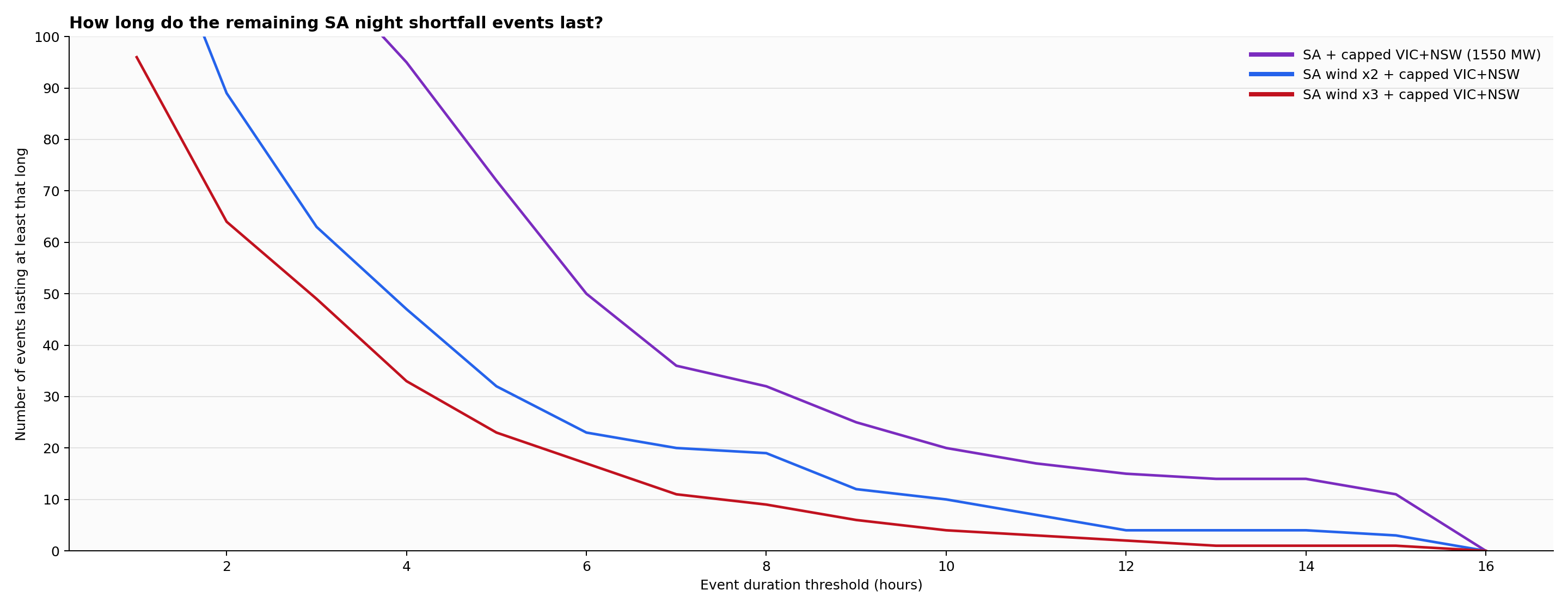
With South Australian wind alone, long shortfall runs are common. That is exactly the sort of thing critics of renewable-heavy systems worry about, and rightly so.
But once I add the stronger eastern-support case — South Australian wind plus capped support from Victoria and NSW — the curve drops sharply. Double South Australian wind, and it drops further. Triple it, and further again.
So the good news from the previous article was real. Wind plus stronger interconnection really does make a big dent.
But this chart also adds the realism that the earlier energy totals can blur.
Even in 2025, under the stronger eastern-support case, there are still roughly thirty nights with eight or more consecutive hours of remaining shortfall. Double South Australian wind and that falls to roughly twenty. Triple it and it gets down toward ten.
That is much better.
But it is not “problem solved.”
And these are not tiny misses. Spread across those 8+ hour runs, the remaining gap is still on the order of hundreds of megawatts, and in the base case it is closer to the scale of about a gigawatt than to the scale of one small emergency peaker. In other words: this is backup-plant territory, not something you wave away.
Then the obvious question: what if 2025 was a good year?
So I reran the exercise using wind conditions from each year back to 2015, while holding 2025 night demand and the 2025 wind fleet assumptions fixed.
That gives a cleaner stress test:
If today’s or planned system had existed earlier in the decade, which wind year would have been toughest?
For the eastern-support cases, the answer is 2017.
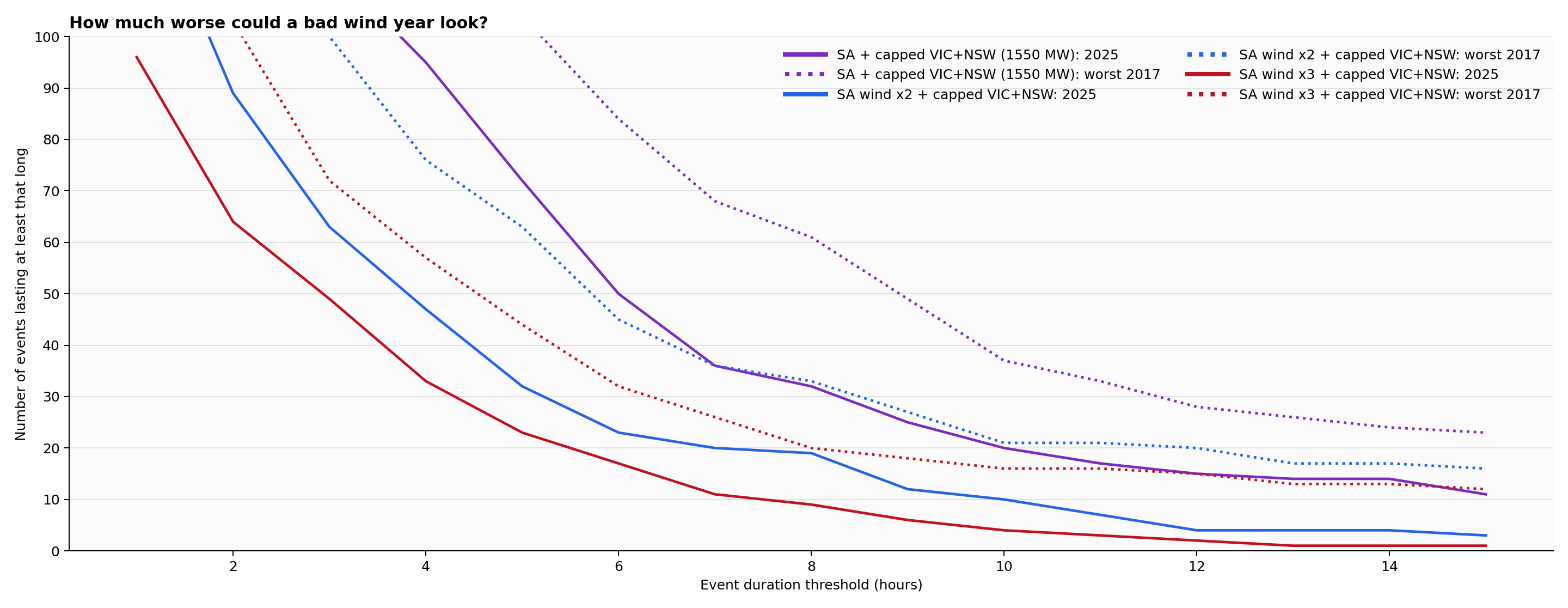
And the bad-year picture is noticeably rougher than the 2025 chart.
In the stronger eastern-support case, the number of 8-hour-plus shortfall runs rises from roughly thirty in 2025 to roughly sixty in the worst replay year. Double South Australian wind and the bad-year number is still in the thirties. Even with 2x SA wind, last year’s result was around twenty such runs.
That is a pretty useful way to picture the problem.
A decent wind year can make the system look manageable.
A bad wind year can roughly double the number of long ugly nights.
And again, the residual gap in those long runs is not trivial. In the bad-year replay, you are looking at something closer to a gigawatt-scale backup problem than a few loose odds and ends.
So the story is mixed.
The earlier encouraging result survives: stronger eastern support helps a lot, and more South Australian wind helps a lot.
But the weather-year replay shows that the tail can come roaring back in a bad year.
This is where gas re-enters the picture
This is also where the debate gets less ideological and more practical.
If the problem were mostly one-hour dents, batteries would look like the overwhelmingly obvious answer. And batteries are indeed part of the answer.
But once you start seeing long consecutive shortfall runs, especially in bad wind years, you are back in the world of firm backup.
That can be gas. It can be hydro if you have enough interconnection to somewhere with dispatchable hydro. It can be some combination of gas, batteries and demand response. But it has to be something that can sit there and carry the system through the tail.
This is why I think the political presentation of the transition can be misleading.
A state can turn off its own gas plants. It can declare progress. It can issue the press release.
But if it is still depending on interconnectors to a wider grid that contains gas and coal, the underlying engineering problem has not disappeared. It has been partly exported.
That may still be a perfectly sensible strategy. South Australia is a small state attached to a much larger system. That is an easier problem than asking Victoria to do the same thing.
But it is not the same as saying the problem no longer exists.
So what should we take from this?
The previous article’s encouraging result was real: wind plus interconnectors can dramatically shrink South Australia’s night-time problem.
But duration matters. The issue is not only how much energy is missing in total. It is how often you get long consecutive runs where wind plus interconnection still do not cover demand.
And the weather-year replay matters even more. In a bad wind year, those long runs become much more common.
So my conclusion is pretty simple:
South Australia’s night-time problem looks solvable, but not by wishful thinking.
It looks solvable by some mixture of:
a lot of wind
stronger interconnection
storage
and firm backup for the ugly tail
That is less romantic than saying “the batteries have won” or “the gas era is over.”
But it is more believable.
One final caveat: these are still simplified thought experiments, not a full dispatch model, and the historical replay is cleaner for South Australia than for Victoria or NSW because the eastern wind fleets were smaller in the earlier years.
Still, the broad lesson is hard to miss:
A decent year can make the problem look manageable.
A bad year can roughly double the number of long bad nights.
And that is where firm backup earns its keep.
The next question is Victoria — and that is where South Australia’s status as a small state attached to larger neighbours may turn out to matter a great deal.
New York proponents of wind and solar point to other jurisdictions where much more renewable capacity has come online and say that we should do more. The South Australia experience you describe compared to recent New York weather shows why this is argument is absurd. New York rooftop solar capacity was 2% for 11 days after big snowstorm was followed by continuous below freezing temperatures. https://pragmaticenvironmentalistofnewyork.blog/2026/03/25/january-february-2026-winter-weather-proves-the-need-for-defr/
New York energy experts recognize the need for zero emissions firm backup for these ugly tails but the renewable proponents have so far ignored the risk of depending on something that does not exist. It is madness.
Maybe check the data more widely. Many have greater wind drought concerns.
https://rafechampion.substack.com/p/wind-droughts-achieve-15-minutes?utm_source=share&utm_medium=android&r=17bedn